 |
 |
 |
|
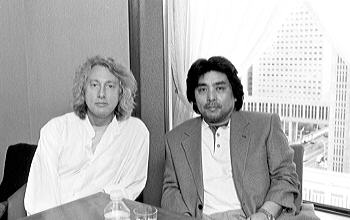
Steve Erickson (1950-) Novelist, free-lance editor. Born in Santa Monica, California. His literary works include "Days Between Stations" (1985), "Rubicon Beach" (1986), "Tours of the Black Clock"(1989), "The Arc d'X"(1993). His latest book is "American Nomad"(1997), which deals with the 1996 presidential campaign. |
Ryu Murakami (1952-) Novelist, Film maker. Born in Sasebo, Nagasaki. His novels include "Almost Transparent Blue"(1976), "Coin Locker Babies" (1980), "Sixty-Nine" (1985), and "Five Miniutes After"(1994). One of his films "Tokyo Decadence" was premiered at Toronto Film festival in 1992. |

|
Steve Erickson (SE): I would like to break the ice by saying thank you for
the kind and generous comments you gave to my most recent novel "Days
Between Stations" (1985) here in Japan. I really appreciate them. Your
endorsement means a lot and I imagine it will be very helpful, too.
Ryu Murakami (RM): Well, I was pretty much surprised that a writer like you had come out from America. The way you see things is very unique. But first of all, I would like to ask you how you usually start a new novel. What kind of process do you go through?
SE : I would be thinking about the novel for a while before I start. I
feel the need to, what we call in the United States, "build up a head of
steam," to gather my energy for the work, which is not to say that I
spend too much time thinking it out exactly. I want to have a sense of the
work, I want to have a sense of the characters. I have a general map in my
head where I'm going to go, but at the same time, I want to leave room for
the surprises, the accidents. And then I usually write a book relatively
quickly, within somewhere between eight and twelve months. As I go along,
I revise intensely. RM : In the case of "Coin Locker Babies", the way I wrote it was very much like yours. Ever since I made my debut as a writer, I had always been interested in movie making. Before writing this book, I was preparing some scripts for a certain director, and actually this book was the result of three of these scripts combined together. So naturally, before writing this book, I had a sense of place and characters. But while actually writing this book, every time I set back and started writing, there occured a certain change, consciously as well as subconsciously. Even though the book had come out of a script for a movie, I unconsciously wanted to make something different, something that you could not depict in a movie. Probably the dreamlike or illusionary parts were for the book, not for the movie. It took me ten months to finish this. SE : That's very fast for a novel of this length. One thing that I was struck by was that, for all of the wide ranging nature of what happens narratively in this book, and for all of the different ongoing adventures of the various characters, the book never loses track of the single defining trauma which comes at the very beginning, and the book always finds a way to refer back to the beginning. It always finds a way for that beginning to have a resonance in everything else that happens.
RM : Actually, several years before I started writing this book, there were
several cases in Japan where babies were abandoned in coin lockers. Most
of these babies were already dead. The parents or whoever would throw away the
corpse in coin lockers. However, some of these babies were still alive.
Some would even survive. Now what if these babies grew up and found out
that they had been cast away in a coin locker. Wouldn't it be easy for
them to build up a tremendous hatred for the world? Wouldn't it be easy
for them to want to destroy it? SE : The characters are suffering the most profound kind of alienation, which is to say, they are alienated from their own birth. The greatest holocaust of their lives has come on the very first day of their birth. Nothing else that happens to them can really be as terrible as that. And they know that.
RM : Also there was another hint. Before writing this book, I read an
article about a certain way of treatment for emotionally unstable children.
I think it was in America where they make them listen to a recording of
the mother's heartbeat from within the body. Just the way you would hear
it if you were in the womb. It seems that the sound of the heartbeat has
the power to make people calm down and relax. SE : I wasn't familiar with that technique. Of course in this book, if these characters were listening to the heartbeats of their mothers, they would be hearing the heartbeat of the person who betrayed them the most. It would calm them and enrage them at the same time. RM : But important things do calm us and enrage us at the same time, don't they? That's the way it is. Now I would like to change the subject and ask another question. Are you making a record of your dreams, writing down your dreams?
SE : I did, for a novel that I wrote a couple of years ago, called
"Amnesiascope" (1996). I wrote down my dreams partly because I'm now getting
old enough that I don't remember anything. And I've never been really good
at remembering my dreams to begin with.
RM : I read "Tours of the Black Clock" (1989) and "Rubicon Beach" (1987) almost
at the same time. But especially after reading "Rubicon Beach", I started
to write down what I saw in my dreams. This is a very interesting task but
also a very difficult one. First of all, since I'm a writer, I tend to make
my dreams more interesting than it should be. Because of this I tend to forget
the original version. SE : Thank you very much. I don't know if any other writer has NOT done it. Since I am a pretty subconscious writer, I'm not even sure if it was something that I was really aware of. But as a matter of fact, after I wrote and published "Days Between Stations", the best compliment that I got, maybe the best compliment that I have ever got, was... somebody said to me one day, "You know, I was trying to think of this dream I had, and then I realized it wasn't a dream. It was your novel that I had read." So I became more aware of a certain kind of dream logic that I think probably dictates my books... in the same way that cinema can capture that dream logic.
RM : Of course the novel is a very old way of expression. To tell you the
truth, it is hard to believe that it still exists. But anyway, all
writers must, in one way or another, be aware of or be conscious of other
kinds of expression within their own age. For example, the works of
writers like Joyce or Proust are different from those of the writers who
didn't know movies.
SE : In at least much of American fiction over the last thirty or forty
years, the American literary imagination has been usurped by movies and
rock'n roll. And since that has not happened to the same extent in South
America, the South American writers seem to have a conviction about their
illusions that most North American writers don't have. RM : It's OK not to be postmodern. Why not? And you are not obsolete at all. To the contrary, I think your work is the very new. Reading your books, I hear Bach, Bob Dylan, and also sometimes The Velvet Underground, --I don't know whether you like their music or not--Doors, Charlie Parker, John Coltrane. But at the same time, the music that I hear from your work is so unique. American pop music has not yet been able to produce the content or substance that your world has. SE : Thank you again. When I was a film student at UCLA, I somehow intuitively decided that I needed to make a choice. I could either be a novelist or a film maker, but from the way I was creatively wired or creatively connected, I wasn't going to be able to do both. I'm struck by the fact that you are. I wonder if you feel a division in your creative psyche in order to do this, or if the literature informs the film and the film informs the literature. And finally I would just like to add that the Velvet Underground is the greatest American rock band of all.
RM : The switches or the channels that I use to write novels and to make
movies are of course different. I guess I will have to explain how it is
in Japan. Now Japan is a very small, flat, unified world. Everything is
very small and very much the same. There are no Others. It intends to be
relaxing but it can also be dull. You can't meet with the New, or the
Strange. SE : I assume "Coin Locker Babies" came out before the movie "Tokyo Decadence". Did "Tokyo Decadence" have the same impact in Japan that it had outside of Japan? RM : In Japan, it was almost neglected. Of course the young people seemed to have liked it but the academic movie critics almost ignored it.
SE : I first saw "Tokyo Decadence" (Japanese title "Topaz",1988) at the
1992 Toronto Film Festival. People lined up for hours in order to see it.
It was THE sensation of the film festival. I've now seen it three times.
The third time was yesterday in Nagoya. The first time I saw it.... Being
squeamish about certain things and worrying about the young woman in the film,
I watched it in a state of anxiety. And the second time I saw it I had the
reaction that the audience at Toronto had, which was finding the film in some
ways outrageously funny, with the emphasis on "outrage." And the third time I
saw it, it struck me as a really lyrically beautiful movie. The decadence, and
even the depravity at times, had a lyricism about it that I found hypnotic and
sometimes very sexy. RM : Maybe so. Maybe you should tell me where you were interrupted so I can cut the movie there. SE : It's where the heroine is stoned and out of it, and she has gone to look for the man she is in love with and the police are dragging her off.
RM : Yes, maybe that IS a good place to end the movie.
 COORDINATOR : Yoshiaki Koshikawa TRANSLATOR : Reiko Tochigi TAPE TRANSCRIPTION : Chikako Kawatani NOTE : This is an English excerpt of an article which has appeared in the July issue of the literary magazine, "Shincho".
|